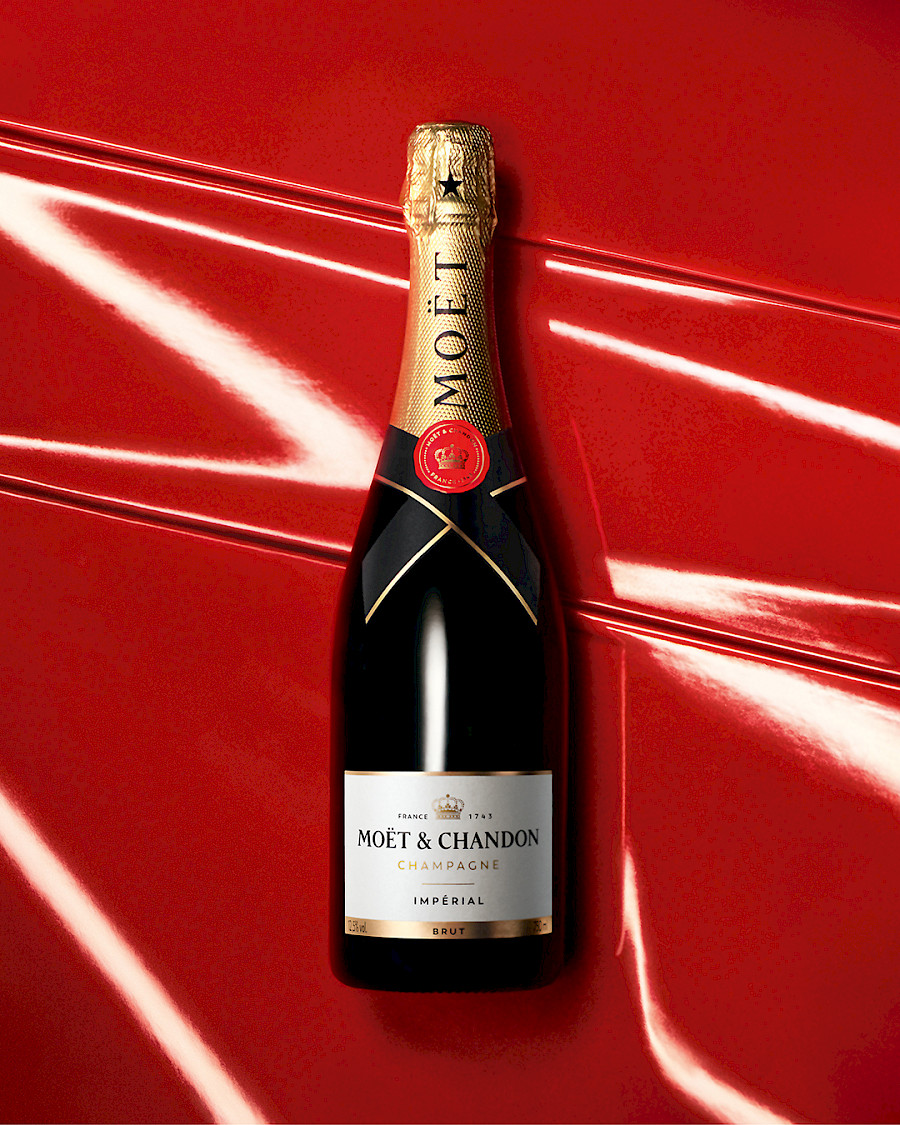
Moët & Chandon’s connection with motorsport stretches back more than a century, long before champagne became synonymous with victory on the podium. Its early association with racing appeared in US advertisements as far back as 1903 and 1904, featuring its White Seal cuvées. In 1905, a press article covering the Coupe Automobile Forézienne recorded Moët & Chandon champagne being served at the evening banquet in the salons of the Automobile Club Forézien.
By the 1920s, the House’s presence had extended to the racetrack itself. In 1924, a Moët & Chandon advertisement appeared at the Lyon racetrack, while signs lined the La Baule circuit. A decade later, the House organised a grand banquet to welcome the Automobile Club de Champagne. These early encounters with the world of racing laid the foundations for a relationship that would become increasingly intertwined with victory and celebration.
The tradition of celebrating victory with Moët & Chandon on the podium began in 1936, when Tazio Nuvolari won the Vanderbilt Cup on Long Island. At the time, Labourdette, Moët & Chandon’s US agent, had taken a keen interest in motor racing and attended the race, where leading European drivers competed against American drivers from Indianapolis. Nuvolari received the silver Vanderbilt Cup from American billionaire George Vanderbilt, while Labourdette presented him with a jeroboam of the 1926 Imperial Crown. The presence of a Moët & Chandon jeroboam on the podium soon became iconic.
The House’s connection with racing, however, deepened in France. In 1950, Frédéric Chandon de Briailles and Paul Chandon-Moët organised a reception at the Château de Saran in honour of Juan Manuel Fangio, winner of the French Grand Prix in Reims. From 1954, Fred Chandon and his cousin Paul, both passionate about motor racing, organised a party and dinner at the Château de Saran after each Grand Prix held in Reims, including the French Grand Prix. Each winner received a Moët & Chandon jeroboam of Brut Impérial, making the House’s champagne a familiar presence at races on the Reims circuit.
The tradition soon extended beyond Reims. In 1959, Moët & Chandon became part of the celebrations at the 24 Hours of Le Mans, where the winner received a bottle as soon as they crossed the finish line.
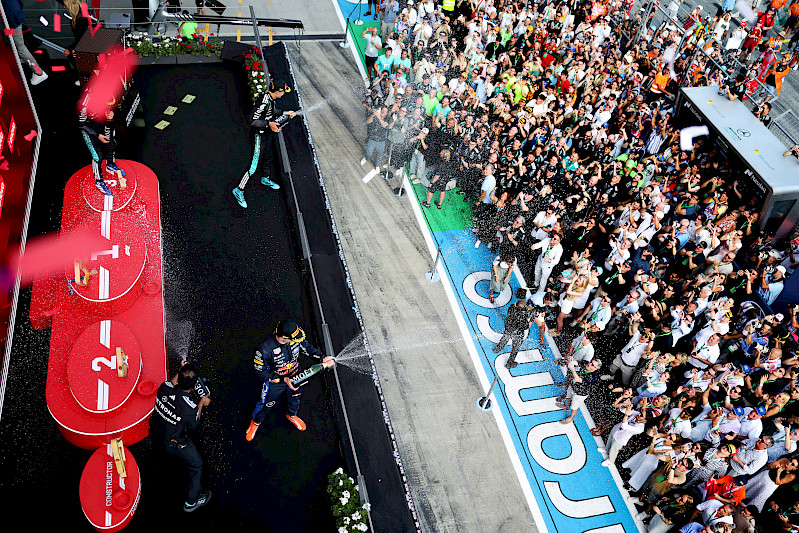
From 1964, Jean-Marie Dubois, director of public relations at Moët & Chandon, presented the jeroboam to the winners on the podium. Two years later, he took charge of the newly created Moët Club at Le Mans, which quickly became an essential venue for victorious drivers and the House’s guests. It provided the setting for one of the most famous moments in the House’s motorsport history: in 1967, Dan Gurney celebrated his victory by brandishing the bottle until the cork popped, spraying champagne over the audience, including House executives and Henry Ford II. The following year, the gesture was deliberately repeated, establishing the tradition of spraying champagne in celebration. Moët & Chandon’s presence at Le Mans continued until 1991.
The 1950s also marked the beginning of Moët & Chandon’s association with Formula 1, particularly through the French Grand Prix at Reims-Gueux. During the 1970s, the House expanded its involvement beyond Reims, further strengthening its presence in Formula 1. Beginning in 1971, a jeroboam of Brut Impérial was presented to winners at the finish line or on the podium at several Grand Prix races.
In 1977, the Moët & Chandon Golden Magnum F1 Trophy was introduced for the six best drivers of the season, with the fastest driver receiving 100 bottles of champagne. At the time, Moët & Chandon’s presence on the podium was not yet contractual: victory bottles were awarded through relationships between the House and individual drivers or specific markets.
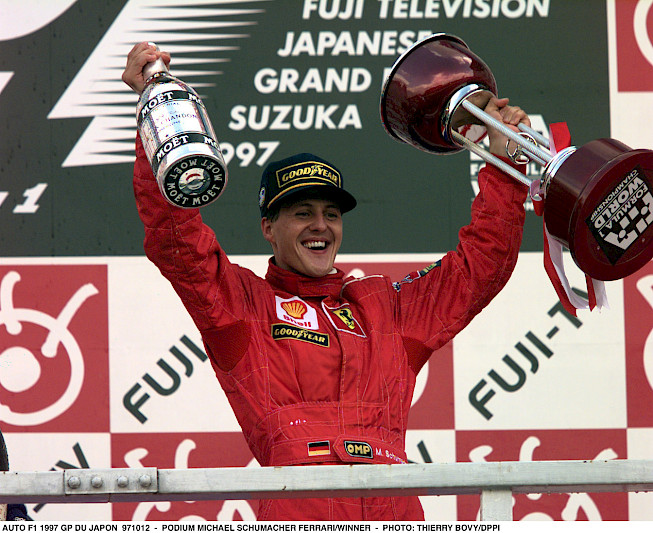
Everything changed in 1981, when Moët & Chandon became an official supplier to the FIA. From then on, podium victories were celebrated with the House’s famous jeroboams under an agreement renewed several times until 1997. From 1991, four jeroboams were used for each podium: one for each of the top three finishers, while the fourth was signed by the three drivers and added to the House’s collection. In just six years, a total of 51 signed jeroboams were collected.
In 1996, Moët & Chandon launched the Moët Silver Trophy, a silver jeroboam engraved by a craftsman. Three copies were produced, with trophies awarded to the driver, constructor, and engine manufacturer with the most victories during the season. During the 1996 and 1997 seasons, the winner of each Grand Prix also received a Silver Jeroboam on the podium, while the fully engraved and personalised Silver Trophy was presented at the end of the season. Special Formula One Silver Trophy packaging was also created for a bottle and a magnum.
In 2025, Moët & Chandon returned to Formula 1 as part of LVMH’s 10-year partnership with the championship, renewing the historic alliance.
Moët & Chandon also maintained a presence in rallying, although on a more occasional basis. The House appeared on the podium of the Monte Carlo Rally in 1952, 1975, 1994 and 1995, while also organising its own motoring events. The Moët Rally of Champions brought together friends of the House for a range of activities, from car races and hill climbs in Saran Park to straddle-tractor driving.
Five editions were held in partnership with car manufacturers: the Moët-Matra Rally in 1970, the Moët-Ford Rally in 1971, the Moët-Renault Rally in 1972, and the Moët-Ford Rally again in 1973 and 1979.
 |
 |
The House also created prizes and events for rally drivers. In 1982, it launched the Moët France Trophy, awarded to the five drivers with the best performances in the special stages of rallies counting towards the French championship. The House later introduced the Moët Rally Special, based on the same principle, as part of the World Rally Championship.
In 1986, it launched the annual Volant des Chefs, bringing together 35 chefs and 15 drivers to compete on the Pau Arnos circuit. Nine editions were held until 1995, followed by a one-off revival in 2013.
Beyond competition, Moët & Chandon’s passion for motorsport found expression in a series of celebrations. In 1987, a special gathering marking the legendary Ferrari 250 GTO’s 25th anniversary took place in Épernay at the Moët & Chandon House, where the cars gathered around the Orangerie pond. The House welcomed the Ferraris and their drivers back to Saran for the marque’s 35th anniversary in 1997 and again for its 40th anniversary in 2002. For the Ferrari 250 GTO’s 45th anniversary in 2007, the celebration moved to California with the Moët & Chandon Fabulous Tour in Napa Valley, where a specially designed Solo trunk, created in collaboration with Louis Vuitton for the occasion, contained four bottles of Grand Vintage, eight flutes, and a wine cooler.