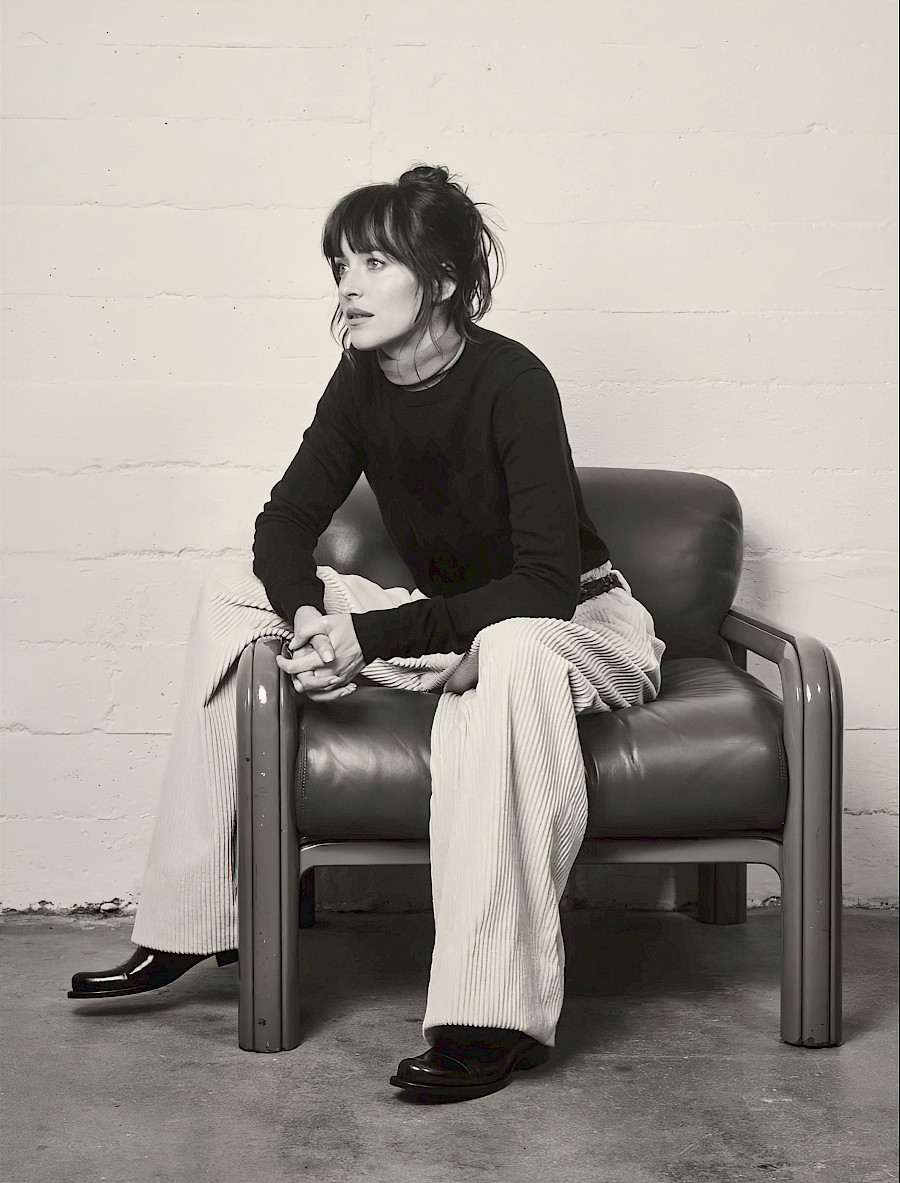
The daughter of Oscar-winning Melanie Griffith and Hollywood heartthrob Don Johnson, she long ago stopped being just “the daughter of famous parents.” For millions, she became Anastasia Steele in the Fifty Shades trilogy – a role that brought her global fame but didn’t entirely define her. This year, Dakota Johnson made her debut at the Cannes Film Festival with Splitsville, a provocative comedy about modern relationships, where she not only stars but also serves as producer. What begins as a playful story soon unfolds into a complex love quadrangle, balancing freedom and desire on a fragile edge. Right after the film’s premiere in Cannes, we had the chance to speak with Dakota. So, get ready for an unforgettable journey into the world of cinema.
After Fifty Shades, that label stuck with me
How did this project begin?
I met the team behind Splitsville about a year and a half ago, and even then, they already had the idea for the film. Later, they went on a trip where they wrote the script. When they came back with the finished text, they asked me to join as a producer. At that point, it wasn’t even discussed that I would also act in it. As a producer, I immediately felt that this story had the potential to become something special. It amazed me that a project like this could stay under the radar without attracting broader attention. But sometimes that’s how it goes in this industry, even the most powerful stories sometimes need a little help to be brought into the light. Michael Covino is a remarkable director, and together with Kyle Marvin, they make an exceptional writing duo. Their work combines both intelligence and emotional depth. That’s exactly why we love collaborating with creators like them, perhaps not the most famous, but incredibly talented.
I’m not interested in endless sequels or remakes. There’s no challenge in that kind of filmmaking. What truly excites me is the freshness of perspective: hearing new stories, watching a director take their first bold steps. In those moments, you feel that you’re part of something new – and you’re learning as you go. For me, that’s the most inspiring part of the work.
Who is your character, Julie?
First and foremost, she’s a woman who’s simply exhausted – tired of everything and everyone around her. She’s increasingly irritated by the behaviour of those closest to her, friends, partners, and it feels as if every day brings new disappointments and small betrayals. All of that builds up inside her, turning into a quiet fatigue and
deep longing for change. At that point, she agrees to try an open relationship, not out of curiosity or a desire for freedom, but more as a way to please her partner, while sensing that their usual patterns no longer work. Deep down, she already knows that even this experiment won’t fix their problems. It’s such a fragile emotional state – the realisation that not everything can or should be held onto at any cost. It was important to show that truth. Julie doesn’t have ready-made answers; she’s just trying to live through her experience with honesty.
What inspired you to start producing films?
At some point, I realised that just being an actress wasn’t enough for me. When you join a project purely as a performer, you often end up in situations where what happens on set feels one way, yet what you see on screen is something entirely different.
More than once, I’ve sat at a premiere watching a finished film for the first time and thought, “This isn’t what we made, not what I poured my energy into.” It’s a strange feeling, almost as if a part of your experience has been taken away. Sometimes the final result is wonderful, sometimes deeply disappointing – but either way, there’s always that lingering sense of lost control. I wanted to be involved in every stage, from how a story takes shape on paper to how the atmosphere is built on set.
Filmmaking is incredibly hard work. Shooting days are long, and the conditions can be brutal. But when the team feels that they’re creating something together, when people are genuinely invested, everything changes. Even in the toughest circumstances, people work with joy because they know they’re creating something that matters.
Your company, TeaTime Pictures, has existed for six years now. It’s known for championing women’s voices in every form and format. Looking back, what are you most proud of?
I’m proud of everything we’ve achieved over these years. But more than anything, I’m proud of our working dynamic. I have an amazing partner, Ro Donnelly. I think it’s rare in this industry, or in any creative field, to find someone with whom you share an almost telepathic connection. With Ro, that’s exactly what it feels like. She’s like the other half of my brain. We think alike, share the same taste, and see the world in a similar way. I genuinely believe women have a kind of superpower – this ability to sense nuances and understand one another without words. Most of the people who work at our company are women, though we did just recently hire our first man.
Film premieres are not only about the movie itself, but also about glamour, style, and the red carpet. Do you have any personal rituals or secrets for these moments?
I always work with people who genuinely adore me, because only then is my look created with real love. My makeup artist, Georgie, has been with me for about six years, and I see him as a kindred spirit.
My hairstylist, Mark Townsend, or just Marky, has been doing my hair for twelve years. I’m actually very attached to my hair, and even when I get the urge to change something, I rarely go through with it. So, the only space left for experimentation is my wardrobe.
How do you feel about fashion?
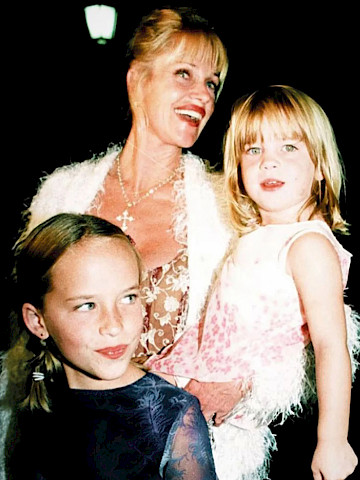
I’ve always had a very personal relationship with fashion. Even as a child, I wouldn’t let anyone dress me. I used to lock myself in my mother’s dressing room for hours, trying on her clothes and experimenting with the most extravagant looks. I especially loved her vintage, custom-made Levi’s; they had such character.
What do you do when you finally have a day off?
I sleep. I can literally sleep through an entire day. I also love taking baths at any time of day. Whenever I’m tired or something upsets me, I immediately jump into the water; it always calms me down. After I’ve rested, I usually go back to my routine: yoga, Pilates, and transcendental meditation, which I practice twice a day.
Growing up as the daughter of two movie stars, you must have understood fame from a very young age. What was that like?
Even so, I’ve never liked having all eyes on me – and I don’t think I’ll ever get used to it. Growing up in that kind of atmosphere made me realise very early on how people react to those they idolise. That kind of attention can make you feel awkward, even vulnerable.
Sometimes it’s almost frightening. I actually think people who constantly crave being in the spotlight are, in a way, quite lost. Still, I do my job and understand that I owe something to the audience. And it’s genuinely fulfilling to know that people connect with and appreciate what I do.
Sometimes the final result is wonderful, sometimes deeply disappointing
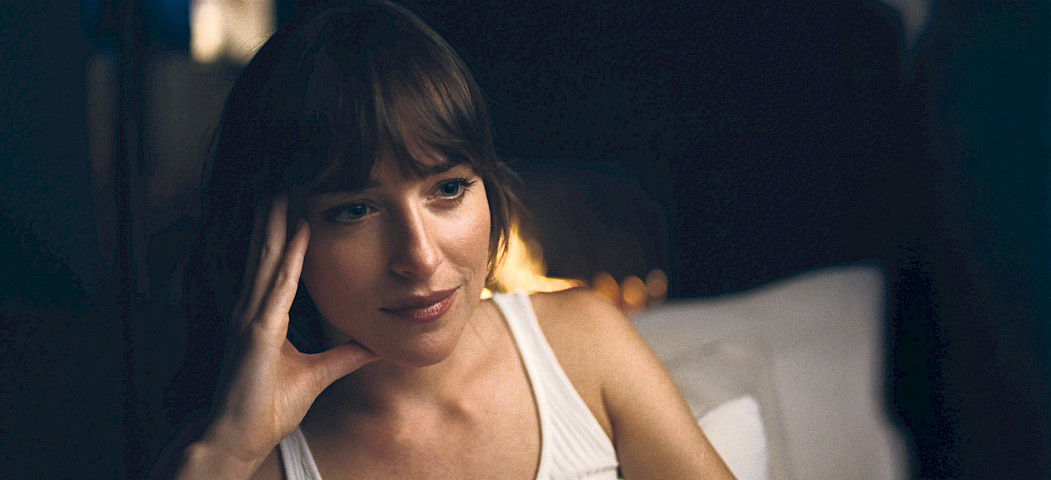
How did Hollywood react to Fifty Shades of Grey? Did you feel that the offers became more interesting?
You mean offers to star in adult films? Luckily, not every script I was sent had to do with eroticism – though quite a few did. After Fifty Shades, that label stuck with me for a long time, and I had to prove that I could be someone different. But eventually, that phase passed.
Your mother was famously reluctant to watch Fifty Shades of Grey. Why was that?
Honestly, I didn’t want my family to watch it either – for obvious reasons. I thought it would be inappropriate. But later I told myself, “At the end of the day, it’s just a movie. Nothing terrible will happen if they see it.” In the end, my sister watched it and told me she was proud of me.
Does belonging to a famous family ever get in the way of your career?
It’s both a blessing and a burden. On one hand, I grew up seeing how the industry works, surrounded by artists and actors, and that gave me a unique kind of insight. Without that early exposure, I don’t think I’d be able to work the way I do now. But on the other hand, I’m constantly being asked about my parents, their fame, and my family.
Every day feels like I have to explain my life all over again. After a while, that becomes exhausting, and honestly, a bit irritating.
Do you have a backup plan in case you ever decide to leave the film industry?
I’ve always wanted to work in the cinema. But if I really think about it, my other passion is baking. I could totally see myself owning a small bakery one day. Why not? It’s a pretty sweet alternative.
Women have a kind of superpower
- Like her grandmother Tippi Hedren, Dakota is an animal rights activist; she saved 12 horses from being killed in 2014 by paying for them.
- Her favourite book is the 1955 novel Lolita by Vladimir Nabokov.
- Whenever Dakota is truly laughing, she cries.
- Three things she always carries in her purse: keys, lip balm, and candy.